

Key Takeaways
HVAC filter rating
An HVAC filter rating is a number that tells you how effectively an air filter traps particles like dust, pollen, mold spores, and pet dander as air passes through your heating and cooling system. Higher numbers generally mean finer filtration and smaller particles captured. Three separate rating systems exist: MERV, MPR, and FPR, each developed by a different organization.
MERV (Minimum Efficiency Reporting Value) is the original ASHRAE standard (ASHRAE 52.2) and the most widely used across the industry. MPR and FPR are proprietary scales created by specific manufacturers.
Why filter ratings exist
When you buy an air filter at a hardware store, the package displays at least one rating number. That number answers a basic engineering question: what percentage of airborne particles does this filter remove, and at what particle size?
Without a standard scale, comparing filters from different manufacturers would be guesswork. The MERV scale, created by ASHRAE (the American Society of Heating, Refrigerating and Air-Conditioning Engineers), became the industry baseline. It tests filters at multiple particle sizes and assigns a score based on the worst-performing size range, which is why it is called a minimum efficiency rating.
Two manufacturers later created their own scales for marketing purposes. Understanding all three helps you shop without confusion.
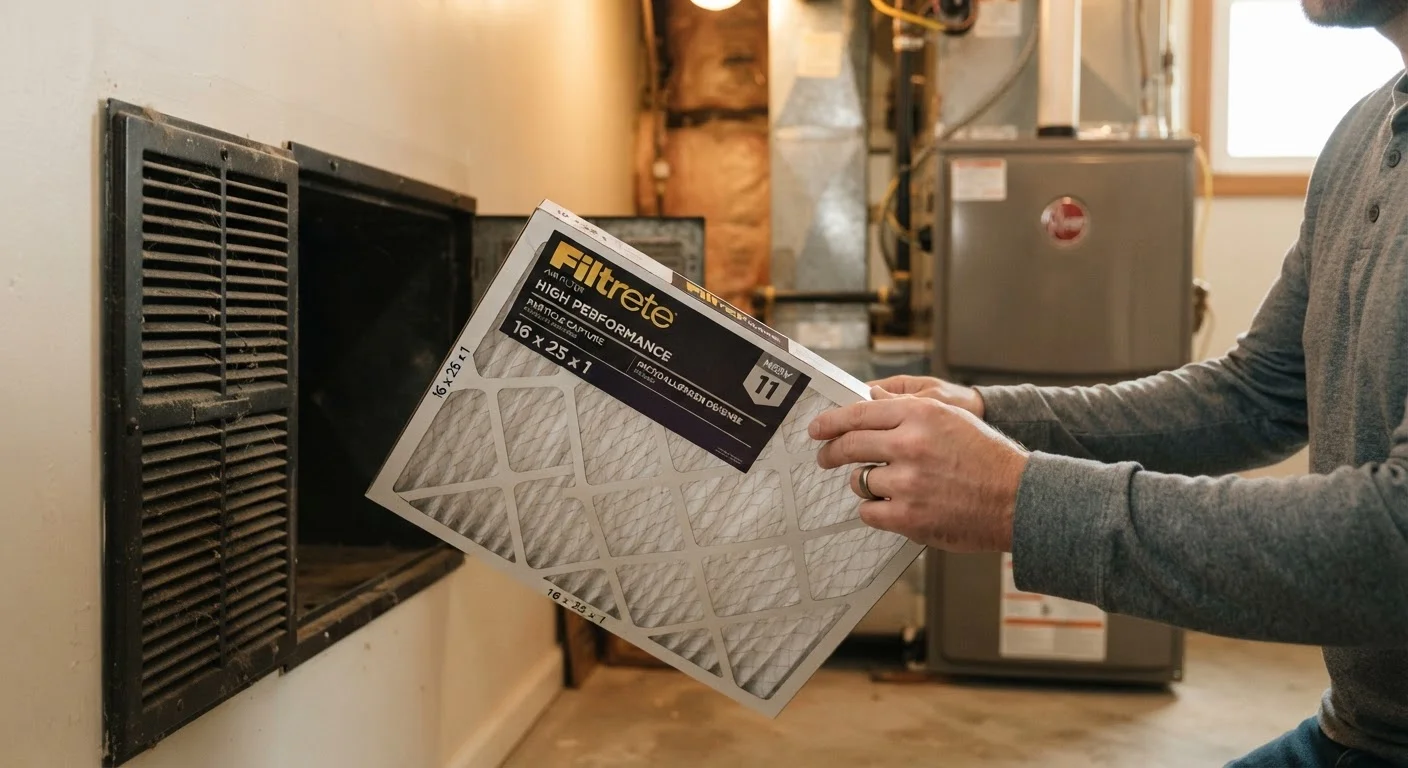
Photograph your current filter label
Before buying a replacement, take a photo of the label on your existing filter. It shows the exact dimensions and the current MERV, MPR, or FPR rating your system is using. This makes it easy to buy the same specification or make a deliberate, informed change rather than guessing by size alone.
The three rating systems side by side
MERV (1 to 20)
Residential HVAC systems typically use filters rated MERV 1 to 16. The scale breaks down roughly as follows:
- MERV 1 to 4: fiberglass panel filters, captures large lint and dust particles only
- MERV 5 to 8: pleated filters, captures mold spores, pollen, and most household dust
- MERV 9 to 12: captures finer dust, pet dander, and some smoke particles
- MERV 13 to 16: captures fine particles including bacteria and tobacco smoke; common in hospitals and commercial buildings
MPR (Micro-Particle Performance Rating)
MPR focuses specifically on particles smaller than 1 micron. Numbers run from 300 to 2800. A rough conversion: MPR 600 is close to MERV 8, MPR 1000 is close to MERV 11, and MPR 1900 is close to MERV 13.
FPR (Filter Performance Rating)
FPR uses a 4 to 10 scale with color coding. FPR 4 corresponds roughly to MERV 8, and FPR 10 to MERV 12 or 13. Because it uses a narrower scale, small differences between filters can appear larger than they are on the MERV scale.
MERV 8
Minimum rating for meaningful pollen and dust capture
ASHRAE recommends MERV 8 as a baseline for residential air quality in its guidance on indoor air quality for occupied spaces.
30 to 90 days
Typical replacement interval for 1-inch pleated filters
Most filter manufacturers recommend this range for standard residential use under normal occupancy and pet conditions.
MERV 13
Threshold for capturing fine particles including bacteria
At MERV 13, filters capture particles as small as 0.3 to 1 micron, the range that includes many airborne bacteria and fine smoke particles.
Choosing the right rating for your system
The most common mistake homeowners make is assuming the highest-rated filter is always the right choice. A denser filter creates more resistance to airflow, measured in HVAC engineering as pressure drop. If your blower motor cannot compensate, several problems can follow: reduced airflow to rooms, longer run cycles, higher energy bills, and in some cases a frozen evaporator coil or overheated heat exchanger.
Before upgrading your filter rating, check two things. First, look up your HVAC system's documentation for the manufacturer's recommended filter specifications. Second, check the filter slot itself: a system designed for 1-inch filters cannot accept a 4-inch filter without a physical retrofit, but even within the same thickness, a MERV 13 filter in a system rated for MERV 8 can restrict airflow noticeably.
For most single-family homes with standard equipment, MERV 8 to 11 gives good particle capture with acceptable pressure drop. Households with allergy sufferers or pets often benefit from MERV 11 to 13, provided the system supports it.
Filter maintenance and real-world performance
A filter's rated performance applies to a clean filter. As a filter loads with dust, its efficiency actually increases temporarily because the accumulated particles help trap new ones. However, the pressure drop increases at the same time, so a heavily loaded filter eventually hurts airflow more than it helps air quality.
The practical takeaway: replace filters on a consistent schedule rather than waiting until they look completely gray. For a 1-inch pleated filter rated MERV 8 to 11, a 60 to 90-day replacement interval works for most households. If you have multiple pets, live in a dusty climate, or recently completed renovation work, check the filter monthly.
Thicker filters (4 to 5 inches) have more surface area and hold more debris before restriction becomes a problem. They can last 6 to 12 months in typical use. However, they require a compatible filter cabinet, so verify the fit before purchasing.
This article is for general informational purposes only. Consult your HVAC system's documentation and, where appropriate, a licensed HVAC technician before making changes to your system's filtration setup.